Edited, memorised or added to reading queue
on 20-Sep-2026 (Sun)
Do you want BuboFlash to help you learning these things? Click here to log in or create user.
Flashcard 149623447
| status | not learned | measured difficulty | 37% [default] | last interval [days] | |||
|---|---|---|---|---|---|---|---|
| repetition number in this series | 0 | memorised on | scheduled repetition | ||||
| scheduled repetition interval | last repetition |
Parent (intermediate) annotation
Open itAn example of this is where an institution swaps the cash flows on a U.S. Government Bond for LIBOR minus a spread (say 20 basis points)
Original toplevel document
Asset swap - Wikipedia, the free encyclopediaing) or to pay off debts. In finance, the term asset swap has a particular meaning.[1] When one refers to an asset swap, one has in mind the exchange of the flow of payments from a given security (the asset) for a different set of cash flows. <span>An example of this is where an institution swaps the cash flows on a U.S. Government Bond for LIBOR minus a spread (say 20 basis points). Such swaps usually have stub periods in order to bring the chronology of the cash flows into line with that of the underlying bond. Contents 1 Introduction 1.1 Mechanics of a Par A
Flashcard 149623477
| status | not learned | measured difficulty | 37% [default] | last interval [days] | |||
|---|---|---|---|---|---|---|---|
| repetition number in this series | 0 | memorised on | scheduled repetition | ||||
| scheduled repetition interval | last repetition |
Parent (intermediate) annotation
Open itThe asset swap market is over-the-counter (OTC), i.e., not traded on any exchange
Original toplevel document
Asset swap - Wikipedia, the free encyclopediaith the swap market in the early 1990s, and continued to be most widely used by banks which use asset swaps to convert their long-term fixed rate assets to floating rate in order to match their short-term liabilities (depositor accounts). [2] <span>The asset swap market is over-the-counter (OTC), i.e., not traded on any exchange. There are several variations on the asset swap structure with the most widely traded being the par asset swap. Other types include the market asset swap and the cross-currency asset sw
Flashcard 149623539
| status | not learned | measured difficulty | 37% [default] | last interval [days] | |||
|---|---|---|---|---|---|---|---|
| repetition number in this series | 0 | memorised on | scheduled repetition | ||||
| scheduled repetition interval | last repetition |
Parent (intermediate) annotation
Open itIn the market asset swap, the net upfront payment is zero. Instead the notional on the Libor side equals the price of the bond and there is an exchange of notionals at maturity.
Original toplevel document
Asset swap - Wikipedia, the free encyclopediaeen floating side coupons, the floating payment received is half of the Libor plus asset swap spread. This feature prevents the calculated asset swap spread from jumping as we move forward in time through coupon dates. Market Asset Swap[edit] <span>In the market asset swap, the net upfront payment is zero. Instead the notional on the Libor side equals the price of the bond and there is an exchange of notionals at maturity. See also[edit] Government debtInterestSwap (finance) References[edit] ^ "Asset Swap - Investopedia". Investopedia. Archived from the original on 12 April 2009. Retrieved 2009-0
Flashcard 149623546
| status | not learned | measured difficulty | 37% [default] | last interval [days] | |||
|---|---|---|---|---|---|---|---|
| repetition number in this series | 0 | memorised on | scheduled repetition | ||||
| scheduled repetition interval | last repetition |
Parent (intermediate) annotation
Open itIn the market asset swap, the net upfront payment is zero. Instead the notional on the Libor side equals the price of the bond and there is an exchange of notionals at maturity.
Original toplevel document
Asset swap - Wikipedia, the free encyclopediaeen floating side coupons, the floating payment received is half of the Libor plus asset swap spread. This feature prevents the calculated asset swap spread from jumping as we move forward in time through coupon dates. Market Asset Swap[edit] <span>In the market asset swap, the net upfront payment is zero. Instead the notional on the Libor side equals the price of the bond and there is an exchange of notionals at maturity. See also[edit] Government debtInterestSwap (finance) References[edit] ^ "Asset Swap - Investopedia". Investopedia. Archived from the original on 12 April 2009. Retrieved 2009-0
Flashcard 149623953
| status | not learned | measured difficulty | 37% [default] | last interval [days] | |||
|---|---|---|---|---|---|---|---|
| repetition number in this series | 0 | memorised on | scheduled repetition | ||||
| scheduled repetition interval | last repetition |
Parent (intermediate) annotation
Open itTED spread is now calculated as the difference between the three-month LIBOR and the three-month T-bill interest rate.
Original toplevel document
TED spread - Wikipedia, the free encyclopediafor three-month U.S. Treasuries contracts and the three-month Eurodollars contract as represented by the London Interbank Offered Rate (LIBOR). However, since the Chicago Mercantile Exchange dropped T-bill futures after the 1987 crash,[1] the <span>TED spread is now calculated as the difference between the three-month LIBOR and the three-month T-bill interest rate. The size of the spread is usually denominated in basis points (bps). For example, if the T-bill rate is 5.10% and ED trades at 5.50%, the TED spread is 40 bps. The TED spread fluctuates
Flashcard 149624199
| status | not learned | measured difficulty | 37% [default] | last interval [days] | |||
|---|---|---|---|---|---|---|---|
| repetition number in this series | 0 | memorised on | scheduled repetition | ||||
| scheduled repetition interval | last repetition |
Parent (intermediate) annotation
Open itmarket price of a 17-year bond with a duration of 7 would fall about 7% if the market interest rate increased by 1% per annum.
Original toplevel document
Bond valuation - Wikipedia, the free encyclopediaof the bond's price with respect to discount rates. For example, for small interest rate changes, the duration is the approximate percentage by which the value of the bond will fall for a 1% per annum increase in market interest rate. So the <span>market price of a 17-year bond with a duration of 7 would fall about 7% if the market interest rate (or more precisely the corresponding force of interest) increased by 1% per annum. Convexity is a measure of the "curvature" of price changes. It is needed because the price is not a linear function of the discount rate, but rather a convex function of the di
Flashcard 149624256
| status | not learned | measured difficulty | 37% [default] | last interval [days] | |||
|---|---|---|---|---|---|---|---|
| repetition number in this series | 0 | memorised on | scheduled repetition | ||||
| scheduled repetition interval | last repetition |
Parent (intermediate) annotation
Open itCoupon yield is also called nominal yield.
Original toplevel document
Bond valuation - Wikipedia, the free encyclopediaices are often quoted in terms of YTM. To achieve a return equal to YTM, i.e. where it is the required return on the bond, the bond owner must: buy the bond at price ,hold the bond until maturity, andredeem the bond at par. Coupon yield[edit] <span>The coupon yield is simply the coupon payment as a percentage of the face value . Coupon yield is also called nominal yield. Current yield[edit] The current yield is simply the coupon payment as a percentage of the (current) bond price . Relationship[edit] The concept of current yield is closely related to o
Flashcard 149624263
| status | not learned | measured difficulty | 37% [default] | last interval [days] | |||
|---|---|---|---|---|---|---|---|
| repetition number in this series | 0 | memorised on | scheduled repetition | ||||
| scheduled repetition interval | last repetition |
Parent (intermediate) annotation
Open itCoupon yield is also called nominal yield.
Original toplevel document
Bond valuation - Wikipedia, the free encyclopediaices are often quoted in terms of YTM. To achieve a return equal to YTM, i.e. where it is the required return on the bond, the bond owner must: buy the bond at price ,hold the bond until maturity, andredeem the bond at par. Coupon yield[edit] <span>The coupon yield is simply the coupon payment as a percentage of the face value . Coupon yield is also called nominal yield. Current yield[edit] The current yield is simply the coupon payment as a percentage of the (current) bond price . Relationship[edit] The concept of current yield is closely related to o
Flashcard 149624274

 .
| status | not learned | measured difficulty | 37% [default] | last interval [days] | |||
|---|---|---|---|---|---|---|---|
| repetition number in this series | 0 | memorised on | scheduled repetition | ||||
| scheduled repetition interval | last repetition |
Parent (intermediate) annotation
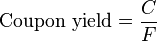
Open itThe coupon yield is simply the coupon payment as a percentage of the face value .
Original toplevel document
Bond valuation - Wikipedia, the free encyclopediaices are often quoted in terms of YTM. To achieve a return equal to YTM, i.e. where it is the required return on the bond, the bond owner must: buy the bond at price ,hold the bond until maturity, andredeem the bond at par. Coupon yield[edit] <span>The coupon yield is simply the coupon payment as a percentage of the face value . Coupon yield is also called nominal yield. Current yield[edit] The current yield is simply the coupon payment as a percentage of the (current) bond price . Relationship[edit] The concept of current yield is closely related to o
Flashcard 149624483
| status | not learned | measured difficulty | 37% [default] | last interval [days] | |||
|---|---|---|---|---|---|---|---|
| repetition number in this series | 0 | memorised on | scheduled repetition | ||||
| scheduled repetition interval | last repetition |
Parent (intermediate) annotation
Open itTED is an acronym formed from T-Bill and ED, the ticker symbol for the Eurodollar futures contract.
Original toplevel document
TED spread - Wikipedia, the free encyclopediay of the TED spread TED spread (in red) and components during the Financial crisis of 2007–08 The TED spread is the difference between the interest rates on interbank loans and on short-term U.S. government debt ("T-bills"). <span>TED is an acronym formed from T-Bill and ED, the ticker symbol for the Eurodollar futures contract. Initially, the TED spread was the difference between the interest rates for three-month U.S. Treasuries contracts and the three-month Eurodollars contract as represented by the London In
Flashcard 149624525
| status | not learned | measured difficulty | 37% [default] | last interval [days] | |||
|---|---|---|---|---|---|---|---|
| repetition number in this series | 0 | memorised on | scheduled repetition | ||||
| scheduled repetition interval | last repetition |
Parent (intermediate) annotation
Open itonly the anticipation of falling interest rates will cause an inverted yield curve.
Original toplevel document
Yield curve - Wikipedia, the free encyclopediabond. The market's anticipation of falling interest rates causes such incidents. Negative liquidity premiums can also exist if long-term investors dominate the market, but the prevailing view is that a positive liquidity premium dominates, so <span>only the anticipation of falling interest rates will cause an inverted yield curve. Strongly inverted yield curves have historically preceded economic depressions. The shape of the yield curve is influenced by supply and demand: for instance, if there is a large demand
Flashcard 149624637
 )
 )


| status | not learned | measured difficulty | 37% [default] | last interval [days] | |||
|---|---|---|---|---|---|---|---|
| repetition number in this series | 0 | memorised on | scheduled repetition | ||||
| scheduled repetition interval | last repetition |
Parent (intermediate) annotation
Open itSpot Price (S)Volatility ()Time to Expiry ()Value (V) Delta Vega Theta Definition of Greeks as the sensitivity of an option's price and risk (in the first column) to the underlying parameter (in the first row). First-order Greeks are i
Original toplevel document
Greeks (finance) - Wikipedia, the free encyclopediaor4.2 Speed4.3 Ultima4.4 Zomma 5 Greeks for multi-asset options6 Formulas for European option Greeks7 Related measures 7.1 Bond duration and convexity7.2 Beta7.3 Fugit 8 See also9 Notes10 References11 External links Use of the Greeks[edit] <span>Spot Price (S)Volatility ()Time to Expiry ()Value (V) Delta Vega ThetaDelta () GammaVannaCharmVega () VannaVommaVetaGamma () SpeedZommaColorVomma UltimaTotto Definition of Greeks as the sensitivity of an option's price and risk (in the first column) to the underlying parameter (in the first row). First-order Greeks are in blue, second-order Greeks are in green, and third-order Greeks are in yellow. Note that vanna appears twice as it should, and rho is left out as it is not as important as the rest. The Greeks are vital tools in risk management. Each Greek measures the sensitivity of the value of a portfolio to a small change in a given underlying parameter, so that component risks
Flashcard 149624648
 )
 )


| status | not learned | measured difficulty | 37% [default] | last interval [days] | |||
|---|---|---|---|---|---|---|---|
| repetition number in this series | 0 | memorised on | scheduled repetition | ||||
| scheduled repetition interval | last repetition |
Parent (intermediate) annotation
Open itSpot Price (S)Volatility ()Time to Expiry ()Value (V) Delta Vega Theta Definition of Greeks as the sensitivity of an option's price and risk (in the first column) to the underlying parameter (in the first row). First-order Greeks are in blu
Original toplevel document
Greeks (finance) - Wikipedia, the free encyclopediaor4.2 Speed4.3 Ultima4.4 Zomma 5 Greeks for multi-asset options6 Formulas for European option Greeks7 Related measures 7.1 Bond duration and convexity7.2 Beta7.3 Fugit 8 See also9 Notes10 References11 External links Use of the Greeks[edit] <span>Spot Price (S)Volatility ()Time to Expiry ()Value (V) Delta Vega ThetaDelta () GammaVannaCharmVega () VannaVommaVetaGamma () SpeedZommaColorVomma UltimaTotto Definition of Greeks as the sensitivity of an option's price and risk (in the first column) to the underlying parameter (in the first row). First-order Greeks are in blue, second-order Greeks are in green, and third-order Greeks are in yellow. Note that vanna appears twice as it should, and rho is left out as it is not as important as the rest. The Greeks are vital tools in risk management. Each Greek measures the sensitivity of the value of a portfolio to a small change in a given underlying parameter, so that component risks
Flashcard 149624993
| status | not learned | measured difficulty | 37% [default] | last interval [days] | |||
|---|---|---|---|---|---|---|---|
| repetition number in this series | 0 | memorised on | scheduled repetition | ||||
| scheduled repetition interval | last repetition |
Parent (intermediate) annotation
Open itThe concept of current yield is closely related to other bond concepts, including yield to maturity, and coupon yield. The relationship between yield to maturity and the coupon rate is as follows: When a bond sells at a discount, YTM > current yield > coupon yield.When a bond sells at a premium, coupon yield > current yield > YTM.When a bond sells at par, YTM = current yield = coupon yield
Original toplevel document
Bond valuation - Wikipedia, the free encyclopedias simply the coupon payment as a percentage of the face value . Coupon yield is also called nominal yield. Current yield[edit] The current yield is simply the coupon payment as a percentage of the (current) bond price . Relationship[edit] <span>The concept of current yield is closely related to other bond concepts, including yield to maturity, and coupon yield. The relationship between yield to maturity and the coupon rate is as follows: When a bond sells at a discount, YTM > current yield > coupon yield.When a bond sells at a premium, coupon yield > current yield > YTM.When a bond sells at par, YTM = current yield = coupon yield Price sensitivity[edit] Main articles: Bond duration and Bond convexity The sensitivity of a bond's market price to interest rate (i.e. yield) movements is measured by its duration, and,
Flashcard 149625004
| status | not learned | measured difficulty | 37% [default] | last interval [days] | |||
|---|---|---|---|---|---|---|---|
| repetition number in this series | 0 | memorised on | scheduled repetition | ||||
| scheduled repetition interval | last repetition |
Parent (intermediate) annotation
Open itis closely related to other bond concepts, including yield to maturity, and coupon yield. The relationship between yield to maturity and the coupon rate is as follows: When a bond sells at a discount, YTM > current yield > coupon yield.<span>When a bond sells at a premium, coupon yield > current yield > YTM.When a bond sells at par, YTM = current yield = coupon yield<span><body><html>
Original toplevel document
Bond valuation - Wikipedia, the free encyclopedias simply the coupon payment as a percentage of the face value . Coupon yield is also called nominal yield. Current yield[edit] The current yield is simply the coupon payment as a percentage of the (current) bond price . Relationship[edit] <span>The concept of current yield is closely related to other bond concepts, including yield to maturity, and coupon yield. The relationship between yield to maturity and the coupon rate is as follows: When a bond sells at a discount, YTM > current yield > coupon yield.When a bond sells at a premium, coupon yield > current yield > YTM.When a bond sells at par, YTM = current yield = coupon yield Price sensitivity[edit] Main articles: Bond duration and Bond convexity The sensitivity of a bond's market price to interest rate (i.e. yield) movements is measured by its duration, and,
Flashcard 149625022
| status | not learned | measured difficulty | 37% [default] | last interval [days] | |||
|---|---|---|---|---|---|---|---|
| repetition number in this series | 0 | memorised on | scheduled repetition | ||||
| scheduled repetition interval | last repetition |
Parent (intermediate) annotation
Open itand coupon yield. The relationship between yield to maturity and the coupon rate is as follows: When a bond sells at a discount, YTM > current yield > coupon yield.When a bond sells at a premium, coupon yield > current yield > YTM.<span>When a bond sells at par, YTM = current yield = coupon yield<span><body><html>
Original toplevel document
Bond valuation - Wikipedia, the free encyclopedias simply the coupon payment as a percentage of the face value . Coupon yield is also called nominal yield. Current yield[edit] The current yield is simply the coupon payment as a percentage of the (current) bond price . Relationship[edit] <span>The concept of current yield is closely related to other bond concepts, including yield to maturity, and coupon yield. The relationship between yield to maturity and the coupon rate is as follows: When a bond sells at a discount, YTM > current yield > coupon yield.When a bond sells at a premium, coupon yield > current yield > YTM.When a bond sells at par, YTM = current yield = coupon yield Price sensitivity[edit] Main articles: Bond duration and Bond convexity The sensitivity of a bond's market price to interest rate (i.e. yield) movements is measured by its duration, and,
Flashcard 149625502
| status | not learned | measured difficulty | 37% [default] | last interval [days] | |||
|---|---|---|---|---|---|---|---|
| repetition number in this series | 0 | memorised on | scheduled repetition | ||||
| scheduled repetition interval | last repetition |
Parent (intermediate) annotation
Open itThe pure expectations (market expectations) hypothesis assumes that the various maturities are perfect substitutes and suggests that the shape of the yield curve depends on market participants' expectations of future interest rat
Original toplevel document
Yield curve - Wikipedia, the free encyclopediag in a credit bubble. Theory[edit] There are three main economic theories attempting to explain how yields vary with maturity. Two of the theories are extreme positions, while the third attempts to find a middle ground between the former two. <span>Market expectations (pure expectations) hypothesis[edit] Main article: expectation hypothesis This hypothesis assumes that the various maturities are perfect substitutes and suggests that the shape of the yield curve depends on market participants' expectations of future interest rates. Using this, future rates, along with the assumption that arbitrage opportunities will be minimal in future markets, and that future rates are unbiased estimates of forthcoming spot rates, is enough information to construct a complete expected yield curve. For example, if investors have an expectation of what 1-year interest rates will be next year, the 2-year interest rate can be calculated as the compounding of this year's interest rate by next year's interest rate. More generally, rates on a long-term instrument are equal to the geometric mean of the yield on a series of short-term instruments. This theory perfectly explains the observation that yields usually move together. However, it fails to explain the persistence in the shape of the yield curve. Shortcomings of expectations theory: Neglects the risks inherent in investing in bonds (because forward rates are not perfect predictors of future rates). 1) Interest rate risk 2) Reinvestment rate risk Liquidity premium theory[edit] The Liquidity Premium Theory is an offshoot of the Pure Expectations Theory. The Liquidity Premium Theory asserts that long-term interest rates not only re
Flashcard 149625513
| status | not learned | measured difficulty | 37% [default] | last interval [days] | |||
|---|---|---|---|---|---|---|---|
| repetition number in this series | 0 | memorised on | scheduled repetition | ||||
| scheduled repetition interval | last repetition |
Parent (intermediate) annotation
Open itThe pure expectations (market expectations) hypothesis assumes that the various maturities are perfect substitutes and suggests that the shape of the yield curve depends on market participants' expectations of future interest rates.
Original toplevel document
Yield curve - Wikipedia, the free encyclopediag in a credit bubble. Theory[edit] There are three main economic theories attempting to explain how yields vary with maturity. Two of the theories are extreme positions, while the third attempts to find a middle ground between the former two. <span>Market expectations (pure expectations) hypothesis[edit] Main article: expectation hypothesis This hypothesis assumes that the various maturities are perfect substitutes and suggests that the shape of the yield curve depends on market participants' expectations of future interest rates. Using this, future rates, along with the assumption that arbitrage opportunities will be minimal in future markets, and that future rates are unbiased estimates of forthcoming spot rates, is enough information to construct a complete expected yield curve. For example, if investors have an expectation of what 1-year interest rates will be next year, the 2-year interest rate can be calculated as the compounding of this year's interest rate by next year's interest rate. More generally, rates on a long-term instrument are equal to the geometric mean of the yield on a series of short-term instruments. This theory perfectly explains the observation that yields usually move together. However, it fails to explain the persistence in the shape of the yield curve. Shortcomings of expectations theory: Neglects the risks inherent in investing in bonds (because forward rates are not perfect predictors of future rates). 1) Interest rate risk 2) Reinvestment rate risk Liquidity premium theory[edit] The Liquidity Premium Theory is an offshoot of the Pure Expectations Theory. The Liquidity Premium Theory asserts that long-term interest rates not only re
Flashcard 149636810
| status | not learned | measured difficulty | 37% [default] | last interval [days] | |||
|---|---|---|---|---|---|---|---|
| repetition number in this series | 0 | memorised on | scheduled repetition | ||||
| scheduled repetition interval | last repetition |
Parent (intermediate) annotation
Open itCurrency swaps are over-the-counter derivatives, and are closely related to interest rate swaps.
Original toplevel document
Currency swap - Wikipedia, the free encyclopediarrency swap, both principal and interest of loan is exchanged from one party to another party for mutual benefits.[2] Contents 1 Structure2 Uses 2.1 Hedging example 3 Examples4 Abuses5 History6 References7 External links Structure[edit] <span>Currency swaps are over-the-counter derivatives, and are closely related to interest rate swaps. However, unlike interest rate swaps, currency swaps can involve the exchange of the principal.[1] There are three different ways in which currency swaps can exchange loans: The simplest
Flashcard 149677841
| status | not learned | measured difficulty | 37% [default] | last interval [days] | |||
|---|---|---|---|---|---|---|---|
| repetition number in this series | 0 | memorised on | scheduled repetition | ||||
| scheduled repetition interval | last repetition |
Parent (intermediate) annotation
Open ite exchanged cash flows are in different denominations and so are not netted. An example of such a swap is the exchange of fixed-rate US dollar interest payments for floating-rate interest payments in Euro. This type of swap is also known as a <span>cross-currency interest rate swap, or cross currency swap.<span><body><html>
Original toplevel document
Currency swap - Wikipedia, the free encyclopediailla interest rate swap) because they are denominated in different currencies. As each party effectively borrows on the other's behalf, this type of swap is also known as a back-to-back loan.[3]Last here, but certainly not least important, is <span>to swap only interest payment cash flows on loans of the same size and term. Again, as this is a currency swap, the exchanged cash flows are in different denominations and so are not netted. An example of such a swap is the exchange of fixed-rate US dollar interest payments for floating-rate interest payments in Euro. This type of swap is also known as a cross-currency interest rate swap, or cross currency swap.[4] Uses[edit] Currency swaps have three main uses: To secure cheaper debt (by borrowing at the best available rate regardless of currency and then swapping for debt in desired currency
Flashcard 1671278759180
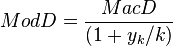
 is the compounding frequency per year (1 for annual, 2 for semi-annual, 12 for monthly, 52 for weekly, etc.),
 is the yield to maturity for an asset, periodically compounded
| status | not learned | measured difficulty | 37% [default] | last interval [days] | |||
|---|---|---|---|---|---|---|---|
| repetition number in this series | 0 | memorised on | scheduled repetition | ||||
| scheduled repetition interval | last repetition |
Parent (intermediate) annotation
Open itwell-known relationship between modified duration and Macaulay duration if yield is periodically compounded (not continually): where: is the compounding frequency per year (1 for annual, 2 for semi-annual, 12 for monthly, 52 for weekly, etc.), is the yield to maturity for
Original toplevel document
Bond duration - Wikipedia, the free encyclopediauously compounded. Then expression (2) becomes: To find modified duration, when we take the derivative of the value with respect to the periodically compounded yield we find [5] Rearranging (dividing both sides by -V) gives: which is the <span>well-known relationship between modified duration and Macaulay duration: where: indexes the cash flows, is the compounding frequency per year (1 for annual, 2 for semi-annual, 12 for monthly, 52 for weekly, etc.), is the cash flow of the th payment from an asset, is the time in years until the th payment will be received (e.g. a two-year semi-annual would be represented by a index of 0.5, 1.0, 1.5, and 2.0), is the yield to maturity for an asset, periodically compounded is the present value of all cash payments from the asset. This gives the well-known relation between Macaulay duration and modified duration quoted above. It should be remembered that, even though Macaulay duration and modified duration are clo
| status | not read | reprioritisations | ||
|---|---|---|---|---|
| last reprioritisation on | suggested re-reading day | |||
| started reading on | finished reading on |
Eurasian eagle-owl - Wikipedia
rmally on their own, but are also sometimes chased away by their parents.[19] The young Eurasian eagle-owls reach sexual maturity by the following year, but do not normally breed until they can establish a territory at around 2–3 years old.[19][22] <span>Until they are able to establish their own territories, young eagle-owls spend their lives as nomadic "floaters", and while they also call, select inconspicuous perch sites unlike breeding birds. Male floaters are especially wary about intrusion into an established territory to avoid potential conspecific aggression.[124] Status [edit] Europe's highest density of Eurasian eagle-owl is
Flashcard 7928199908620
| status | not learned | measured difficulty | 37% [default] | last interval [days] | |||
|---|---|---|---|---|---|---|---|
| repetition number in this series | 0 | memorised on | scheduled repetition | ||||
| scheduled repetition interval | last repetition |
Eurasian eagle-owl - Wikipedia
ritory size is similar or occasionally slightly greater than great horned owl: averaging 15 to 80 km2 (5.8 to 30.9 sq mi).[8][104] Territories are established by the male eagle-owl, who select the highest points in the territory from which to sing. <span>The high prominence of singing perches allows their song to be heard at greater distances and lessens the need for potentially dangerous physical confrontations in the areas where territories may meet.[100] Nearly as important in territorial behaviour as vocalization is the white throat patch. When taxidermied specimens with flared white throats were placed around the perimeter of eagle-ow
ritory size is similar or occasionally slightly greater than great horned owl: averaging 15 to 80 km2 (5.8 to 30.9 sq mi).[8][104] Territories are established by the male eagle-owl, who select the highest points in the territory from which to sing. <span>The high prominence of singing perches allows their song to be heard at greater distances and lessens the need for potentially dangerous physical confrontations in the areas where territories may meet.[100] Nearly as important in territorial behaviour as vocalization is the white throat patch. When taxidermied specimens with flared white throats were placed around the perimeter of eagle-ow
Flashcard 7928202005772
| status | not learned | measured difficulty | 37% [default] | last interval [days] | |||
|---|---|---|---|---|---|---|---|
| repetition number in this series | 0 | memorised on | scheduled repetition | ||||
| scheduled repetition interval | last repetition |
Eurasian eagle-owl - Wikipedia
le for the male, and a more high-pitched and slightly more drawn-out uh-hu for the female.[19] It is not uncommon for a pair to perform an antiphonal duet. The widely used name in Germany as well as some other sections of Europe for this species is <span>uhu due to its song. At 250–350 Hz, the Eurasian eagle-owls territorial song or call is deeper, farther-carrying and is often considering "more impressive" than the territorial songs of the great
le for the male, and a more high-pitched and slightly more drawn-out uh-hu for the female.[19] It is not uncommon for a pair to perform an antiphonal duet. The widely used name in Germany as well as some other sections of Europe for this species is <span>uhu due to its song. At 250–350 Hz, the Eurasian eagle-owls territorial song or call is deeper, farther-carrying and is often considering "more impressive" than the territorial songs of the great
Flashcard 7928204627212
| status | not learned | measured difficulty | 37% [default] | last interval [days] | |||
|---|---|---|---|---|---|---|---|
| repetition number in this series | 0 | memorised on | scheduled repetition | ||||
| scheduled repetition interval | last repetition |
Eurasian eagle-owl - Wikipedia
ous topographic features such as rocky pinnacles, stark ridges and mountain peaks to use as regular song posts. These are dotted along the outer edges of the eagle-owl's territory and they are visited often but only for a few minutes at a time.[10] <span>Vocal activity is almost entirely confined to the colder months from late fall through winter, with vocal activity in October through December mainly having territorial purposes and from January to February being primarily oriented towards courtship and mating purposes.[100] Vocalizations in a Spanish study begin no sooner than 29 minutes after sunset and end no later than 55 minutes before sunrise.[101] The territorial song, which can be heard at great dist
ous topographic features such as rocky pinnacles, stark ridges and mountain peaks to use as regular song posts. These are dotted along the outer edges of the eagle-owl's territory and they are visited often but only for a few minutes at a time.[10] <span>Vocal activity is almost entirely confined to the colder months from late fall through winter, with vocal activity in October through December mainly having territorial purposes and from January to February being primarily oriented towards courtship and mating purposes.[100] Vocalizations in a Spanish study begin no sooner than 29 minutes after sunset and end no later than 55 minutes before sunrise.[101] The territorial song, which can be heard at great dist
Flashcard 7928206724364
| status | not learned | measured difficulty | 37% [default] | last interval [days] | |||
|---|---|---|---|---|---|---|---|
| repetition number in this series | 0 | memorised on | scheduled repetition | ||||
| scheduled repetition interval | last repetition |
Eurasian eagle-owl - Wikipedia
numbers in modern times.[5][126] Eurasian eagle-owls are listed in Appendix II of the Convention on International Trade in Endangered Species (CITES) meaning international trade (including in parts and derivatives) is regulated.[2] Longevity [edit] <span>The Eurasian eagle-owl is one of the longest-living owls.[127] It can live for up to 20 years in the wild. A 19-year-old was once considered the oldest ringed eagle-owl.[19] Some studies posited that, in protected areas, lifespans ranging 15–20 year
numbers in modern times.[5][126] Eurasian eagle-owls are listed in Appendix II of the Convention on International Trade in Endangered Species (CITES) meaning international trade (including in parts and derivatives) is regulated.[2] Longevity [edit] <span>The Eurasian eagle-owl is one of the longest-living owls.[127] It can live for up to 20 years in the wild. A 19-year-old was once considered the oldest ringed eagle-owl.[19] Some studies posited that, in protected areas, lifespans ranging 15–20 year
| status | not read | reprioritisations | ||
|---|---|---|---|---|
| last reprioritisation on | suggested re-reading day | |||
| started reading on | finished reading on |
Eurasian eagle-owl - Wikipedia
bubo Binomial name Bubo bubo (Linnaeus, 1758) Subspecies See text. Range of Eurasian eagle-owl Resident Synonyms Bubo ignavus Forster, 1817 Bubo maximus [3] Strix bubo Linnaeus, 1758 Audio Territorial call of male, recorded near Marianka, Slovakia <span>The Eurasian eagle-owl (Bubo bubo) is a species of eagle-owl, a type of bird that resides much over Eurasia. It is often just called the eagle-owl in Europe and Asia.[4] It is one of the largest species of owl. Females can grow to a total length of 75
Flashcard 7928218782988
| status | not learned | measured difficulty | 37% [default] | last interval [days] | |||
|---|---|---|---|---|---|---|---|
| repetition number in this series | 0 | memorised on | scheduled repetition | ||||
| scheduled repetition interval | last repetition |
Eurasian eagle-owl - Wikipedia
s or wetlands. They also inhabit coniferous forests, steppes, and remote areas. Occasionally, they are found in farmland and in park-like settings in European and Asian cities and, very rarely, in busier urban areas.[6][8] The eagle-owl is mostly a <span>nocturnal predator. Predominantly, they hunt small mammals, such as rodents and rabbits, but also birds and larger mammals. Secondary prey include reptiles, amphibians, fish, large insects, and invertebrates.[5
s or wetlands. They also inhabit coniferous forests, steppes, and remote areas. Occasionally, they are found in farmland and in park-like settings in European and Asian cities and, very rarely, in busier urban areas.[6][8] The eagle-owl is mostly a <span>nocturnal predator. Predominantly, they hunt small mammals, such as rodents and rabbits, but also birds and larger mammals. Secondary prey include reptiles, amphibians, fish, large insects, and invertebrates.[5
| status | not read | reprioritisations | ||
|---|---|---|---|---|
| last reprioritisation on | suggested re-reading day | |||
| started reading on | finished reading on |
Owl - Wikipedia
ng (twilight) in the Mojave Desert, U.S. Further information: Sound localization in owls Owls exhibit specialized hearing functions and ear shapes that also aid in hunting. They are noted for asymmetrical ear placements on the skull in some genera. <span>Owls can have either internal or external ears, both of which are asymmetrical. Asymmetry has not been reported to extend to the middle or internal ear of the owl. Asymmetrical ear placement on the skull allows the owl to pinpoint the location of its prey. This is especi
Flashcard 7928223239436
| status | not learned | measured difficulty | 37% [default] | last interval [days] | |||
|---|---|---|---|---|---|---|---|
| repetition number in this series | 0 | memorised on | scheduled repetition | ||||
| scheduled repetition interval | last repetition |
Parent (intermediate) annotation
Open itd localization in owls Owls exhibit specialized hearing functions and ear shapes that also aid in hunting. They are noted for asymmetrical ear placements on the skull in some genera. Owls can have either internal or external ears, both of which are <span>asymmetrical. Asymmetry has not been reported to extend to the middle or internal ear of the owl. Asymmetrical ear placement on the skull allows the owl to pinpoint the location of its prey. This is espec
Original toplevel document
Owl - Wikipediad localization in owls Owls exhibit specialized hearing functions and ear shapes that also aid in hunting. They are noted for asymmetrical ear placements on the skull in some genera. Owls can have either internal or external ears, both of which are <span>asymmetrical. Asymmetry has not been reported to extend to the middle or internal ear of the owl. Asymmetrical ear placement on the skull allows the owl to pinpoint the location of its prey. This is espec
Flashcard 7928225336588
| status | not learned | measured difficulty | 37% [default] | last interval [days] | |||
|---|---|---|---|---|---|---|---|
| repetition number in this series | 0 | memorised on | scheduled repetition | ||||
| scheduled repetition interval | last repetition |
Parent (intermediate) annotation
Open itOwls can have either internal or external ears, both of which are asymmetrical.
Original toplevel document
Owl - Wikipediang (twilight) in the Mojave Desert, U.S. Further information: Sound localization in owls Owls exhibit specialized hearing functions and ear shapes that also aid in hunting. They are noted for asymmetrical ear placements on the skull in some genera. <span>Owls can have either internal or external ears, both of which are asymmetrical. Asymmetry has not been reported to extend to the middle or internal ear of the owl. Asymmetrical ear placement on the skull allows the owl to pinpoint the location of its prey. This is especi
| status | not read | reprioritisations | ||
|---|---|---|---|---|
| last reprioritisation on | suggested re-reading day | |||
| started reading on | finished reading on |
Owl - Wikipedia
o extend to the middle or internal ear of the owl. Asymmetrical ear placement on the skull allows the owl to pinpoint the location of its prey. This is especially true for strictly nocturnal species such as the barn owls Tyto or Tengmalm's owl.[29] <span>With ears set at different places on its skull, an owl is able to determine the direction from which the sound is coming by the minute difference in time that it takes for the sound waves to penetrate the left and right ears.[32] The owl turns its head until the sound reaches both ears at the same time, at which point it is directly facing the source of the sound. This time difference between ears is about 30 microseconds. Behind the ear openings are modified, dense feathers, densely packed to form a facial ruff, which creates an anterior-facing, concave wall that cups the sound into the ear structure.[33] This
Flashcard 7928229793036
| status | not learned | measured difficulty | 37% [default] | last interval [days] | |||
|---|---|---|---|---|---|---|---|
| repetition number in this series | 0 | memorised on | scheduled repetition | ||||
| scheduled repetition interval | last repetition |
Parent (intermediate) annotation
Open itition: relative;"> With ears set at different places on its skull, an owl is able to determine the direction from which the sound is coming by the minute difference in time that it takes for the sound waves to penetrate the left and right ears.[32] <span>The owl turns its head until the sound reaches both ears at the same time, at which point it is directly facing the source of the sound. This time difference between ears is about 30 microseconds. <span>
Original toplevel document
Owl - Wikipediao extend to the middle or internal ear of the owl. Asymmetrical ear placement on the skull allows the owl to pinpoint the location of its prey. This is especially true for strictly nocturnal species such as the barn owls Tyto or Tengmalm's owl.[29] <span>With ears set at different places on its skull, an owl is able to determine the direction from which the sound is coming by the minute difference in time that it takes for the sound waves to penetrate the left and right ears.[32] The owl turns its head until the sound reaches both ears at the same time, at which point it is directly facing the source of the sound. This time difference between ears is about 30 microseconds. Behind the ear openings are modified, dense feathers, densely packed to form a facial ruff, which creates an anterior-facing, concave wall that cups the sound into the ear structure.[33] This
| status | not read | reprioritisations | ||
|---|---|---|---|---|
| last reprioritisation on | suggested re-reading day | |||
| started reading on | finished reading on |
Owl - Wikipedia
species. The facial disk also acts to direct sound into the ears, and a downward-facing, sharply triangular beak minimizes sound reflection away from the face. The shape of the facial disk is adjustable at will to focus sounds more effectively.[29] <span>The prominences above a great horned owl's head are commonly mistaken as its ears. This is not the case; they are merely feather tufts. The ears are on the sides of the head in the usual location (in two different locations as described above). Talons While the auditory and
Flashcard 7928232938764
| status | not learned | measured difficulty | 37% [default] | last interval [days] | |||
|---|---|---|---|---|---|---|---|
| repetition number in this series | 0 | memorised on | scheduled repetition | ||||
| scheduled repetition interval | last repetition |
Parent (intermediate) annotation
Open ities. The facial disk also acts to direct sound into the ears, and a downward-facing, sharply triangular beak minimizes sound reflection away from the face. The shape of the facial disk is adjustable at will to focus sounds more effectively.[29] The <span>prominences above a great horned owl's head are commonly mistaken as its ears. This is not the case; they are merely feather tufts. The ears are on the sides of the head in the usual location (in two dif
Original toplevel document
Owl - Wikipediaies. The facial disk also acts to direct sound into the ears, and a downward-facing, sharply triangular beak minimizes sound reflection away from the face. The shape of the facial disk is adjustable at will to focus sounds more effectively.[29] The <span>prominences above a great horned owl's head are commonly mistaken as its ears. This is not the case; they are merely feather tufts. The ears are on the sides of the head in the usual location (in two dif
Flashcard 7928235035916
| status | not learned | measured difficulty | 37% [default] | last interval [days] | |||
|---|---|---|---|---|---|---|---|
| repetition number in this series | 0 | memorised on | scheduled repetition | ||||
| scheduled repetition interval | last repetition |
Owl - Wikipedia
ar beak minimizes sound reflection away from the face. The shape of the facial disk is adjustable at will to focus sounds more effectively.[29] The prominences above a great horned owl's head are commonly mistaken as its ears. This is not the case; <span>they are merely feather tufts. The ears are on the sides of the head in the usual location (in two different locations as described above). Talons While the auditory and visual capabilities of the owl allow it to locate a
ar beak minimizes sound reflection away from the face. The shape of the facial disk is adjustable at will to focus sounds more effectively.[29] The prominences above a great horned owl's head are commonly mistaken as its ears. This is not the case; <span>they are merely feather tufts. The ears are on the sides of the head in the usual location (in two different locations as described above). Talons While the auditory and visual capabilities of the owl allow it to locate a
| status | not read | reprioritisations | ||
|---|---|---|---|---|
| last reprioritisation on | suggested re-reading day | |||
| started reading on | finished reading on |
Owl - Wikipedia
dily movement at a minimum, thus reduces the amount of sound the owl makes as it waits for its prey. Owls are regarded as having the most frontally placed eyes among all avian groups, which gives them some of the largest binocular fields of vision. <span>Owls are farsighted and cannot focus on objects within a few centimetres of their eyes.[28][30] These mechanisms are only able to function due to the large-sized retinal image.[31] Thus, the primary nocturnal function in the vision of the owl is due to its large posterior nodal
| status | not read | reprioritisations | ||
|---|---|---|---|---|
| last reprioritisation on | suggested re-reading day | |||
| started reading on | finished reading on |
Owl - Wikipedia
e on the sides of the head in the usual location (in two different locations as described above). Talons While the auditory and visual capabilities of the owl allow it to locate and pursue its prey, the talons and beak of the owl do the final work. <span>The owl kills its prey using these talons to crush the skull and knead the body.[29] The crushing power of an owl's talons varies according to prey size and type, and by the size of the owl. The burrowing owl (Athene cunicularia), a small, partly insectivorous owl, has a
| status | not read | reprioritisations | ||
|---|---|---|---|---|
| last reprioritisation on | suggested re-reading day | |||
| started reading on | finished reading on |
Owl - Wikipedia
nd type, and by the size of the owl. The burrowing owl (Athene cunicularia), a small, partly insectivorous owl, has a release force of only 5 N. The larger barn owl (Tyto alba) needs a force of 30 N to release its prey, and one of the largest owls, <span>the great horned owl (Bubo virginianus), needs a force over 130 N to release prey in its talons.[34] An owl's talons, like those of most birds of prey, can seem massive in comparison to the body size outside of flight. The Tasmanian masked owl has some of the proportionally longest talo
Flashcard 7928265444620
| status | not learned | measured difficulty | 37% [default] | last interval [days] | |||
|---|---|---|---|---|---|---|---|
| repetition number in this series | 0 | memorised on | scheduled repetition | ||||
| scheduled repetition interval | last repetition |
Parent (intermediate) annotation
Open itne cunicularia), a small, partly insectivorous owl, has a release force of only 5 N. The larger barn owl (Tyto alba) needs a force of 30 N to release its prey, and one of the largest owls, the great horned owl (Bubo virginianus), needs a force over <span>130 N to release prey in its talons.[34] An owl's talons, like those of most birds of prey, can seem massive in comparison to the body size outside of flight. The Tasmanian masked owl has some of
Original toplevel document
Owl - Wikipediane cunicularia), a small, partly insectivorous owl, has a release force of only 5 N. The larger barn owl (Tyto alba) needs a force of 30 N to release its prey, and one of the largest owls, the great horned owl (Bubo virginianus), needs a force over <span>130 N to release prey in its talons.[34] An owl's talons, like those of most birds of prey, can seem massive in comparison to the body size outside of flight. The Tasmanian masked owl has some of
Flashcard 7928276454668
| status | not learned | measured difficulty | 37% [default] | last interval [days] | |||
|---|---|---|---|---|---|---|---|
| repetition number in this series | 0 | memorised on | scheduled repetition | ||||
| scheduled repetition interval | last repetition |
Tiger - Wikipedia
innaeus, 1758)[2] Subspecies P. t. tigris P. t. sondaica †P. t. acutidens †P. t. soloensis †P. t. trinilensis Tiger distribution as of 2022 Synonyms[3] Felis tigris Linnaeus, 1758 Tigris striatus Severtzov, 1858 Tigris regalis Gray, 1867 The tiger (<span>Panthera tigris) is a large cat and a member of the genus Panthera native to Asia. It has a powerful, muscular body with a large head and paws, a long tail and orange fur that fades to white in parts,
innaeus, 1758)[2] Subspecies P. t. tigris P. t. sondaica †P. t. acutidens †P. t. soloensis †P. t. trinilensis Tiger distribution as of 2022 Synonyms[3] Felis tigris Linnaeus, 1758 Tigris striatus Severtzov, 1858 Tigris regalis Gray, 1867 The tiger (<span>Panthera tigris) is a large cat and a member of the genus Panthera native to Asia. It has a powerful, muscular body with a large head and paws, a long tail and orange fur that fades to white in parts,